My daughter Marielle has been acting especially wild lately, waking us up with her energy, her screeches of delight while playing with her brother. This has prompted me to sit the twins down and have them think up "rules of the house." After years of their exuberances-- not cleaning up, not eating at the table, using the couch as a bouncy house, not following simple directions, not getting dressed for school on time, not being polite, respectful, etc., etc.--I had had enough. I needed to rein in control. I had the kids come up with the rules, guiding them when necessary. Every teacher knows that rules can only be enforced if kids take ownership. But even this is terribly idealistic.
One day when we were at my sister's house, Marielle was especially wild, racing around doing that screech of hers. I told her to calm down, not act like a banshee. She said what's a banshee; I said something wild. She said, I am supposed to act this way. I am a kid. I replied, I am a grown up; I am supposed to discipline you when you do. She harrumpfed and walked away.
That got me thinking about kids, what they want, what they should be allowed to do, allowed to have, allowed to believe. Should I allow my daughter to run wild, act like a banshee sometimes? Sure, I pick my battles, but I wonder, do I get on her too much? Should I learn to let things go, despite the rules? And just when should I let go and let them do, believe, be, what they want?
When my son came into our bedroom early morning St. Patrick's Day and asked me if the leprechauns had come and left him a gift, I told him there were no such thing as leprechauns. I turned over, tried to go back to sleep, and he slumped out of the room.
The night before the twins wore green to bed because their teachers told them that if they didn't, the leprechauns would play a trick on them. I was too tired for the facade. My philosophy on imaginary entities is to play them down. Don't get them all hyped up. I got all hyped up about Santa Claus and the magic of Christmas, the cookies, the milk, the reindeer, the sugarplums, and one afternoon my neighbor Sharon Taylor in her rotting tree house with cobwebs and dead bugs put an immediate end to it all. I was, in a word, crestfallen. I was a kid with a boundless imagination who enjoyed a rich inner life. This was disillusionment at best, and I didn't want my kids to experience that. So in the past, we didn't write letters to Santa; we didn't leave him cookies. We mentioned him in passing, like he was just a means to an end.
And yet, the way my son slumped silently out of the room, and my daughter went from room to room looking for evidence of little green men, proved to me that it was a kid's right to believe. It was a kid's right to enjoy the magic of imagination. Sure disillusionment would come later, but we're supposed to live in the moment, aren't we? It's true. I wasn't letting my kids be kids.
So when their father took them out for a couple of hours, I went rock hunting and painted two nuggets gold. I cut shamrocks from green construction paper, crafted a letter about luck on parchment, and sprinkled glitter. It took me about an hour and a half to do all of this. When they came home, Marielle found the stash first, and then the two of them inspected the stones. "I can't believe it! They came!" The thrill was quick, about three minutes and then the rocks were abandoned on the floor and they went on to something else. Because that's what kids do.
I try to enforce the rules when it's necessary. Most of the time it takes my holding dessert over their heads to get the job done. But this does work, despite it being redundant. As for imagination, it's imperative to cultivate that in a kid. This will lead to a rich inner life, a necessary indulgence in the unreal, an indulgence for fiction, stories, games, movies, daydreams, art. Because real life can be inherently dull and we need that alternate life to feel alive.

"Lotus Opening" by L. Folk
Sunday, April 29, 2018

Monday, March 26, 2018
The Incubation Period

Latest painting: Still Life 1, How I find beauty while waiting for spring to truly arrive.
It's taken me a longer time to find my visual voice than my written voice, probably because I don't work at as much. As with poems and stories, however, I do get ideas in my head on how a painting should be. I get inspired by other artists and emulate their ideas. I am still learning about the medium of paint, and in the past this certainly has been an obstacle for me. You can draft a poem or story anywhere, but with painting, there is the medium to master, to make a space for.
I had this particular painting in my head for months; it had a long and committed "incubation period." I learned that term from the writer Brenda Ueland who included putting the pen down and going for a walk as part of her writing process. She said, "when you walk, angels whisper in your ears." There's something about being "away" from the project that allows the anxiety to dwindle and for creativity, like a feral cat, to come creeping into your head. Once the incubation period is over, you will have more ideas, a more complete vision, probably just as complete as if you had white-knuckled it and produced a series of sketches or sentences.
Wednesday, February 28, 2018
The Importance of Literature
I ask myself, why do I teach literature? Why teach writing? Aside from the fact that it fits nicely into my schedule, it isn't all that practical, financially speaking--I make a small fraction of what I used to make as an engineer. The truth is I teach literature because it has meaning for me. I have sacrificed meaningless money for a meaningful avocation.
Studying literature is a lesson in humanity; it teaches us what we intrinsically know but tend to forget because we are too busy striving for that A, or that dream job, or making sure our children are fed. By putting this very intimate knowledge on the page, we bring it to a higher level of awareness, and in this higher level of acknowledgement, we span space and time; we see ourselves in others. This commonality that literature enforces--empathy--is one of the virtues of being a human being. It paves the way for compassion, for making peoples' lives better. We seem to be deviating from the tenets of empathy politically these days; amidst all the insanity of whose button is bigger and who can destroy whom faster, but in literature class, we go back to the basics and the spectrum of experiences and emotions that compose us, translated through exceptionally astute minds.
 |
| Literature Quilt Panel 1 |
We live in a time when the media's saturation of terms results in insensitivity or apathy, but stories can still reach us. Once an issue is personalized, something in us can't help but be engaged. By studying literature, we realize that people who may look differently than us, who may live in different places, from palaces to shitholes, all are capable of the same range of emotion. It’s harder to kill someone when you can see yourself in the eyes of “the other.”
Conversely, in writing, we contribute our own emotions and experiences to the human canon, whether it be journal entries, letters, blog posts, short stories, poems, novels: we contribute our ideas and this should not be taken for granted. This should be championed. There is a significant reward for seeing the self to show up on the page. It makes us wiser.
 |
| Literature Quilt Panel 2 |
 |
| Literature Quilt Panel 3 |
 |
| Literature Quilt Panel 4 |
Or perhaps you will see where in the tapestry it is soiled or worm-eaten, you will feel a sudden rise of inspiration and purpose to make reparations, or you will observe that there are places in the tapestry that are so incredibly vibrant and exotic, you seek to go there. Just knowing that these places exist gives you joy or a sense of adventure or a willingness to indulge yourself. This too is a gift of literature.
 |
| Literature Quilt Panel 5 |
I have taught physics, mathematics, and engineering. I am happy that there is a focus on STEM, because it comes with its own benefits and thinking skills (and some of these are not unlike what you learn in literature and writing classes). But let’s not forget how important literature and writing is, especially now, when old social ills are creeping back in.
Wednesday, January 17, 2018
Five Collages
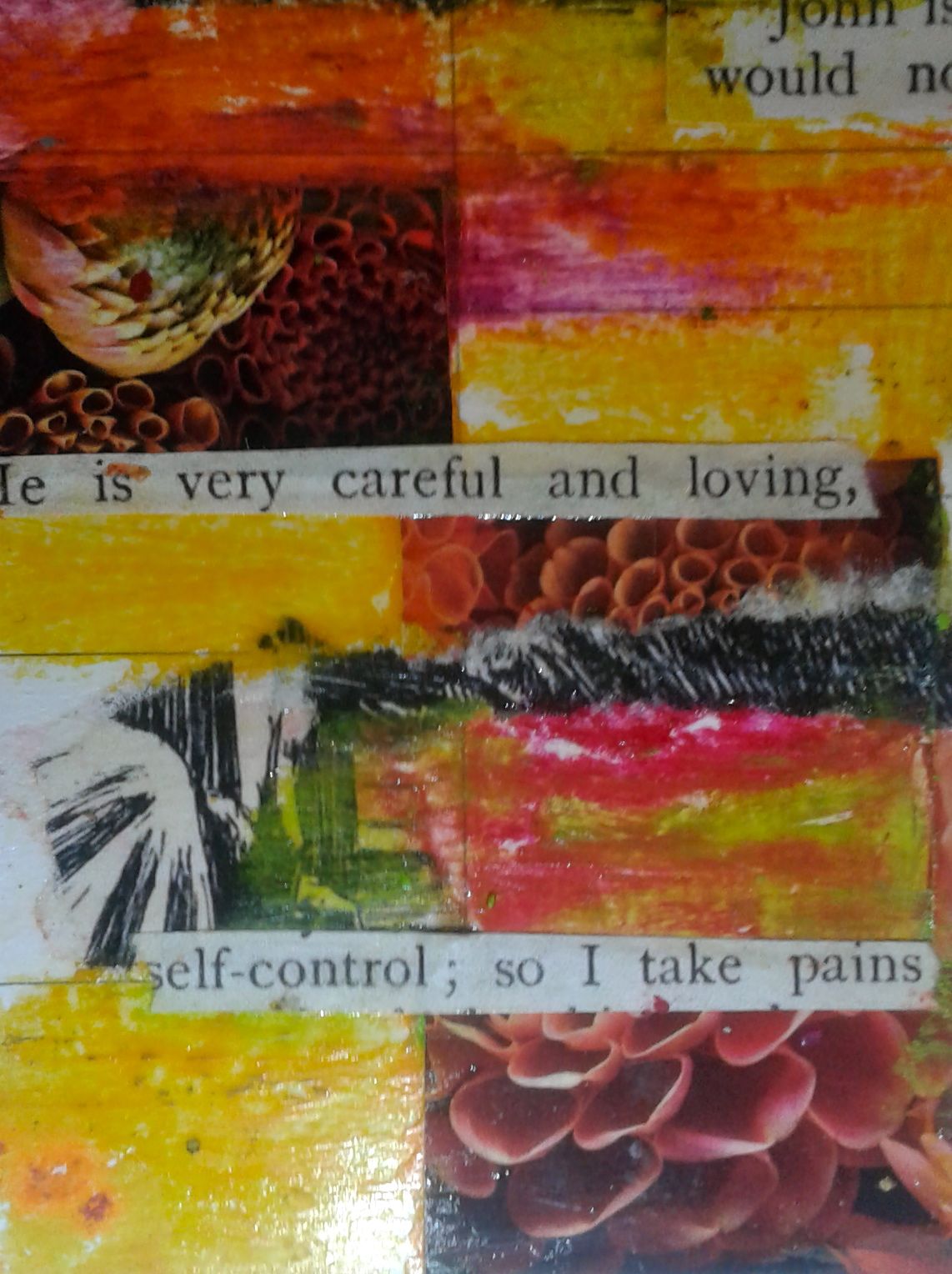
Here are five of my latest collages.
This time of year, when I see pictures of gardens, I literally start to itch for green and lush and bloom. I look forward to planting my garden and starting seeds, which will happen the end of next month. It's a lesson in patience, waiting out winter for spring, but also a time to plan and set intentions. The red petals of the bouquet remind me of a heart.
This collage is my way of not taking winter too seriously. It was
actually created in the midst of summer; this brings to mind what Neil
Diamond famously said about writing songs: you write breakup songs when
you are happily in love and love songs when you are breaking up. The yin
is always curious about the yang.
 | ||
| Bouquet for Life |
 | ||||||
| Winter's House |
The
centerpiece in this collage is actually a tulip that I disassembled and then reassembled to
look more like a flame, which I intend to mean essence. For me, that
essence, that thing I need to keep burning, is my creativity.
 |
| Flame |
 | |||||
| Natural Urges |
This collage portrays summer and sensuality. I was primarily looking for patterns and colors of the natural world when life is warm and easy.
 |
| Lotus Opening |
I titled this collage "Lotus Opening" without knowing that the opening of a lotus represents spiritual awakening. I Googled "lotus opening" and found this out. There is something always working behind the scenes of art, and it's when you become aware and curious that you see what it is.
I suppose if I am living my life correctly, I am always in the throes of a spiritual awakening.
The Fallen Land of Ozymandias
The Fallen Land of Ozymandias
(from the flash fiction collection Upon Waking)
(from the flash fiction collection Upon Waking)
She was angry
with her mother for buying a beaten down cape in New Jersey, half a mile from
an overpass, three quarters of a mile from a beach littered with abandoned
cars, old tires, and discarded clothing. It was ugly and she hated ugly. She
lamented her mother leaving the well-preserved beauty of the New England
landscape, but her mother could no longer afford it. She told her daughter if
she had to move, she'd go south, to the mid-Atlantic states where she could be
closer to extended family. So she did, and her daughter begrudgingly went to
visit her and walk the coarse sand of the polluted beach where someone had
dumped cabinets and suitcases. Her mother said it might have been the mob. The
daughter regarded the tall smoke stacks as they belched fumes into the gray sky
and felt ill.
After lunch, she
took a ride east. It was sunny and she drove with the windows down, the songs
from the radio hampered by the din of the wind. The land, with its enclaves of
reaching blue water, was buzzing with summer activity; people were out jogging,
riding bicycles. She passed a carnival with a Ferris wheel and games of chance.
Tickets littered the streets; people waited in lines for rides and concession
stands where food associated with fun—cotton candy, ice cream, fried dough—was
sold. She passed this place and came to a bridge, a contemporary slender and
elegant structure in decks, towers, and fanning cables that spanned the inlets
of blue, connecting the polluted modern world with the eroded ancient ruins of
the old world. It was a fine summer day now. Indeed, the water is blue,
she thought. On the other side of the bridge was the abandoned land of
Ozymandias, its once enchanting sandstone structures still in place. Here
people wandered through the ruins and pocketed ancient gold coins embossed with
the King of Kings.
She parked the
car, got out and squeezed through an opening in the giant gate. There were
people carrying stacks of books in the ancient streets, looters with scraps of
fool's gold in their hands. Vendors were selling trinkets of the once-great
kingdom; you could buy a t-shirt with Ozymandias's eroded face on it. She
remembered the pope they dug out of the Catacombs, his well-preserved body on
display at the Vatican, the face looking calcified.
The earth
shuddered and she thought Did I imagine that? The great gate creaked and
leaned forward, spreading its arms out to the forgotten world. The people
carrying books dropped them and started running. Chaos and mayhem ensued as
each of the ancient sandstone structures started to crumble. Why now? she
wondered. After thousands of years of being upright, why now? Then she saw a
high school friend on her cell phone just outside the gate. She was still thin,
with long black hair, a cigarette in her hand, imperturbable as the world
rushed by her. She must’ve been talking to her high school sweetheart. She
would take him back, despite what he did, despite what she did—a forgiveness
poised at the end of the world.
Thursday, January 4, 2018
New Year's Day
We walked in the snow down to the river. The air was deeply cold, biting when the wind blew. But the sun shown bright in this crystalized world, and there was evidence of life, tracks in the snow, raccoon, coyote, dog, human, bird. At the banks of the river, the ice has broken; the moon pulled the tide in and now there is this emerald-green pool swollen at the bend. It looks inviting, and if I had fur, I would contemplate diving in. My dog moves toward the pool with an eagerness that scares me. She has the fur--is the river calling to her as well? I beckon her to me, tempt her with a treat and we walk on in this transposed arctic land.
Thoughts of the Jack London story "To Build a Fire" shift in my head. The man in the cold. The man with the matches in his hands. The man unable to light the match. Fumbling. The snow falling on the fire. His thoughts of sticking his hands inside the dog to keep them warm. The dog getting away. The dog more suited to the environment. The dog as survivor.
This is something I have been trying to wrap my head around lately, how the animals survive in this environment. Their adaptations to such severity seem nothing short of miraculous. As a human, I am exempt from this miracle. I am handicapped in this world.
We make our way to the second bend in the river and the wind is so mean across my face, I decide to turn around. Josie bounds ahead. The story says fifty degrees below zero. Do you feel more pain in fifty degrees below zero than you do five? I dangle here, knowing how vulnerable I am. But this is nothing new. I spend my life acutely aware of how vulnerable I am. More attention needs to be given to the strengths, the talents, the skills. The adaptations.
Thoughts of the Jack London story "To Build a Fire" shift in my head. The man in the cold. The man with the matches in his hands. The man unable to light the match. Fumbling. The snow falling on the fire. His thoughts of sticking his hands inside the dog to keep them warm. The dog getting away. The dog more suited to the environment. The dog as survivor.
This is something I have been trying to wrap my head around lately, how the animals survive in this environment. Their adaptations to such severity seem nothing short of miraculous. As a human, I am exempt from this miracle. I am handicapped in this world.
We make our way to the second bend in the river and the wind is so mean across my face, I decide to turn around. Josie bounds ahead. The story says fifty degrees below zero. Do you feel more pain in fifty degrees below zero than you do five? I dangle here, knowing how vulnerable I am. But this is nothing new. I spend my life acutely aware of how vulnerable I am. More attention needs to be given to the strengths, the talents, the skills. The adaptations.
Sunday, December 31, 2017
about:blank
Just start writing. This is what I tell myself as I sit here poised at the end of a somewhat trying year (but seriously, haven't most of them been "trying"?). I am attempting to honor my personal pact, the deal I've made with myself to write at least one post per month, and it is December 31, and I have written nothing for this month. Truth is, I am not that inspired to write anything. I feel blank. I feel like the page you get when your Google search goes awry--about:blank is what the url says. It's a disappointment of sorts, a sudden departure from the instant gratification we've become accustomed to. We almost take it personally. It's as if the computer is telling you, "Look, I really don't care what you are looking for. I am uninspired to show you anything."
It's New Year's Eve and the perpetual student in me would like to make a list of all that I've accomplished and learned. Dot my i-s and cross my t-s, so to speak. But I know these lessons live inside me; I know their names. To state them here seems an exercise in self validation. Perhaps I need this, but truth is, I am too lazy to make the account.
Is that what about:blank is? Laziness? Fatigue? I'm too tired to go and get your website for you. Get it yourself.
And yet, maybe this is the only true way to start out the New Year. No resolutions, no expectations. A blank slate. Leave it to the world to fill it up. It's a measure of patience, really. And faith. We're always pushing, yearning, comparing, checking, and checking some more. Maybe about:blank is about taking a breath. In fact, that's sort of what it looks like: a visual breath, a pasted cloud of breath. Maybe it's stillness. Do you have to be dazzled every second? Do you always have to know where you are headed?
About:blank; no you do not.
It's New Year's Eve and the perpetual student in me would like to make a list of all that I've accomplished and learned. Dot my i-s and cross my t-s, so to speak. But I know these lessons live inside me; I know their names. To state them here seems an exercise in self validation. Perhaps I need this, but truth is, I am too lazy to make the account.
Is that what about:blank is? Laziness? Fatigue? I'm too tired to go and get your website for you. Get it yourself.
And yet, maybe this is the only true way to start out the New Year. No resolutions, no expectations. A blank slate. Leave it to the world to fill it up. It's a measure of patience, really. And faith. We're always pushing, yearning, comparing, checking, and checking some more. Maybe about:blank is about taking a breath. In fact, that's sort of what it looks like: a visual breath, a pasted cloud of breath. Maybe it's stillness. Do you have to be dazzled every second? Do you always have to know where you are headed?
About:blank; no you do not.
Subscribe to:
Posts (Atom)